They Warned Us at Delaney Creek
We walked into Young Lakes out of Tuolumne Meadows on the summer solstice, in on the Glen Aulin trail and home the next day over the Dog Lake side, one night at the water and nothing more ambitious than that. The trip belonged to my close friend, who knows Yosemite the way most people know the roads near their house, and I went where he pointed. A couple stopped us at Delaney Creek on the way in to tell us about the mosquitos, and standing there I could not work out whether to believe them. Thirty hours later we were the ones doing the telling.
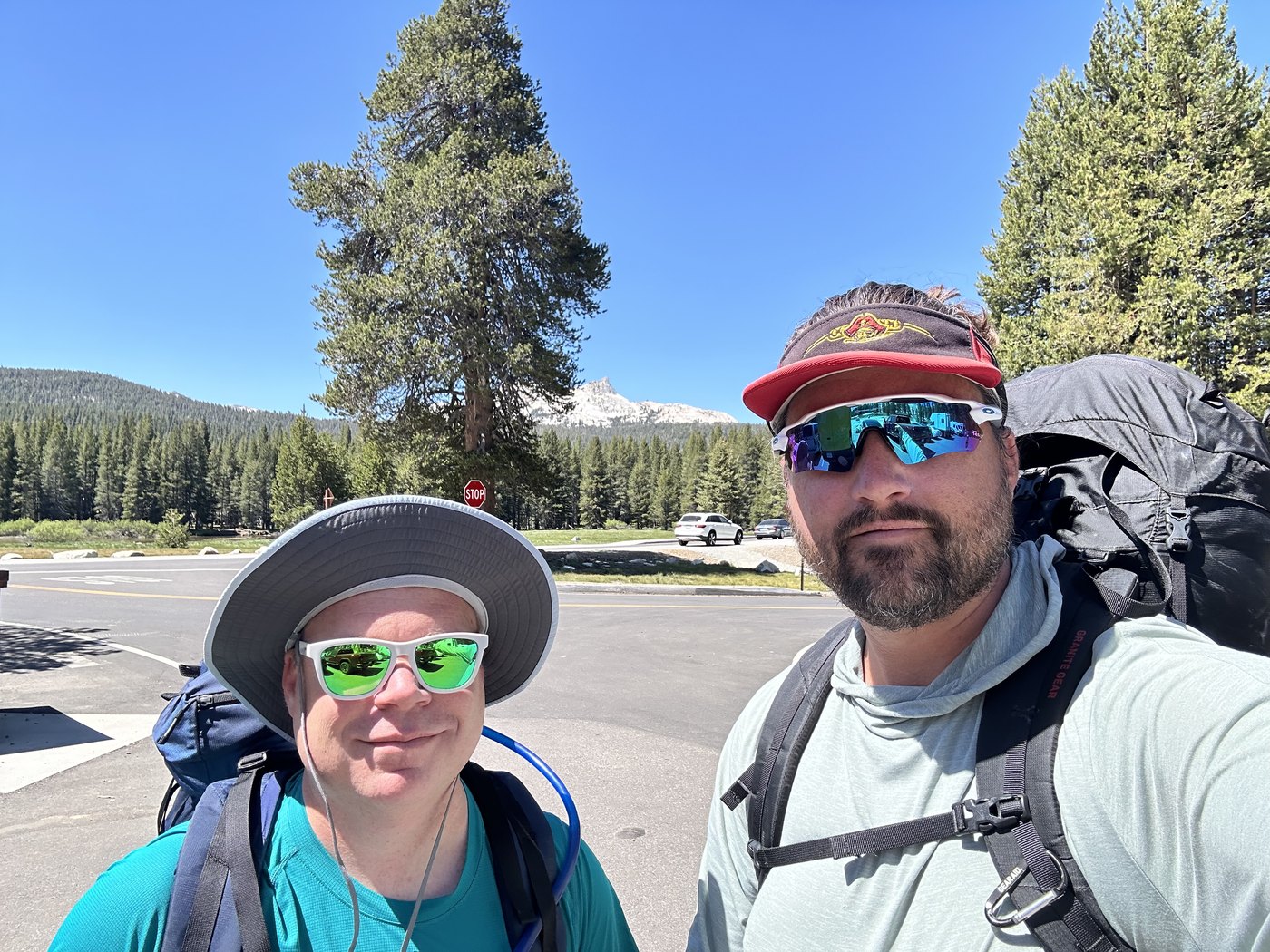
Eleven in the morning at the trailhead, packs on, neither of us carrying any particular worry.
We started walking at one minute past eleven, which is late by the standards of people who write about starting early and about right by the standards of two men who drove up that morning. The trail out of the meadows begins as a dusty road under lodgepoles, wide and flat and busy, and Tuolumne opens on the left in long green sheets with the peaks standing well back. Yosemite gives away that first mile for free. The country up there sits around eight and a half thousand feet before you take a step, so the air is already thin and smells like warm pine duff, and you spend the first half hour feeling stronger than you are.
Delaney Creek comes early. In late June the creek runs wide and shallow and clear over a bed of orange gravel, and getting across is a matter of picking one of the fallen trunks somebody laid there years ago and walking that trunk with your poles out. The couple was standing on our side of the water when we came down to the crossing, already over from the north, and they had no interest in small talk whatsoever. They wanted to tell us about the mosquitos. They talked fast and they talked over each other, and the word they kept coming back to was swarms. They had a loose and friendly look about them, the kind of people who seem to have all afternoon, and both of them looked worn through in a way the walking alone does not account for.
I did not know what to do with the report. Every hiker you meet is calibrated differently, and a stranger's warning arrives with no scale attached. A person who has done one night out will tell you about mosquitos that a person with a hundred nights would not mention. So I said thank you, and my friend said thank you, and we went down to the water.
Nothing happened at the creek. My friend crossed first and I stood on the near bank and took four photographs of him out on the log, which is what you do when the water is pretty and nobody is in danger, and in the whole time the two of us spent getting over that creek not one mosquito came near either of us. Both banks were quiet. As far as we were concerned the question was settled right there, because whatever those two had walked through, the crossing in front of us said the warning was overblown, and by the first switchback we had stopped thinking about the couple entirely.
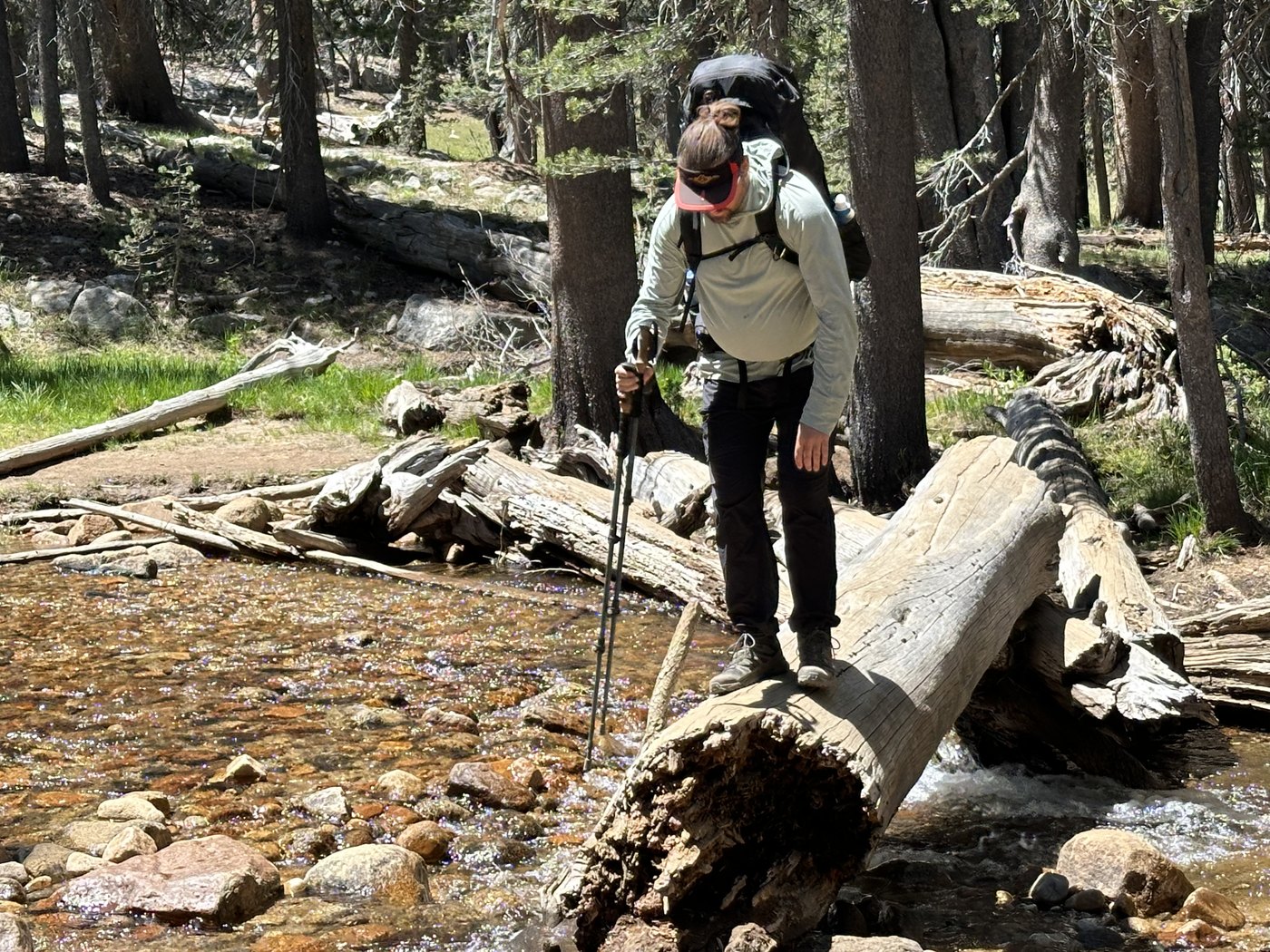
Delaney Creek on the way in, crossed on somebody else's log, with not a mosquito anywhere near the water.
The trail leaves the meadow and climbs steadily through timber for a long time with very little to see. We walked that climb the way you walk any climb like that, which is slowly and without much conversation and stopping when stopping seemed reasonable.
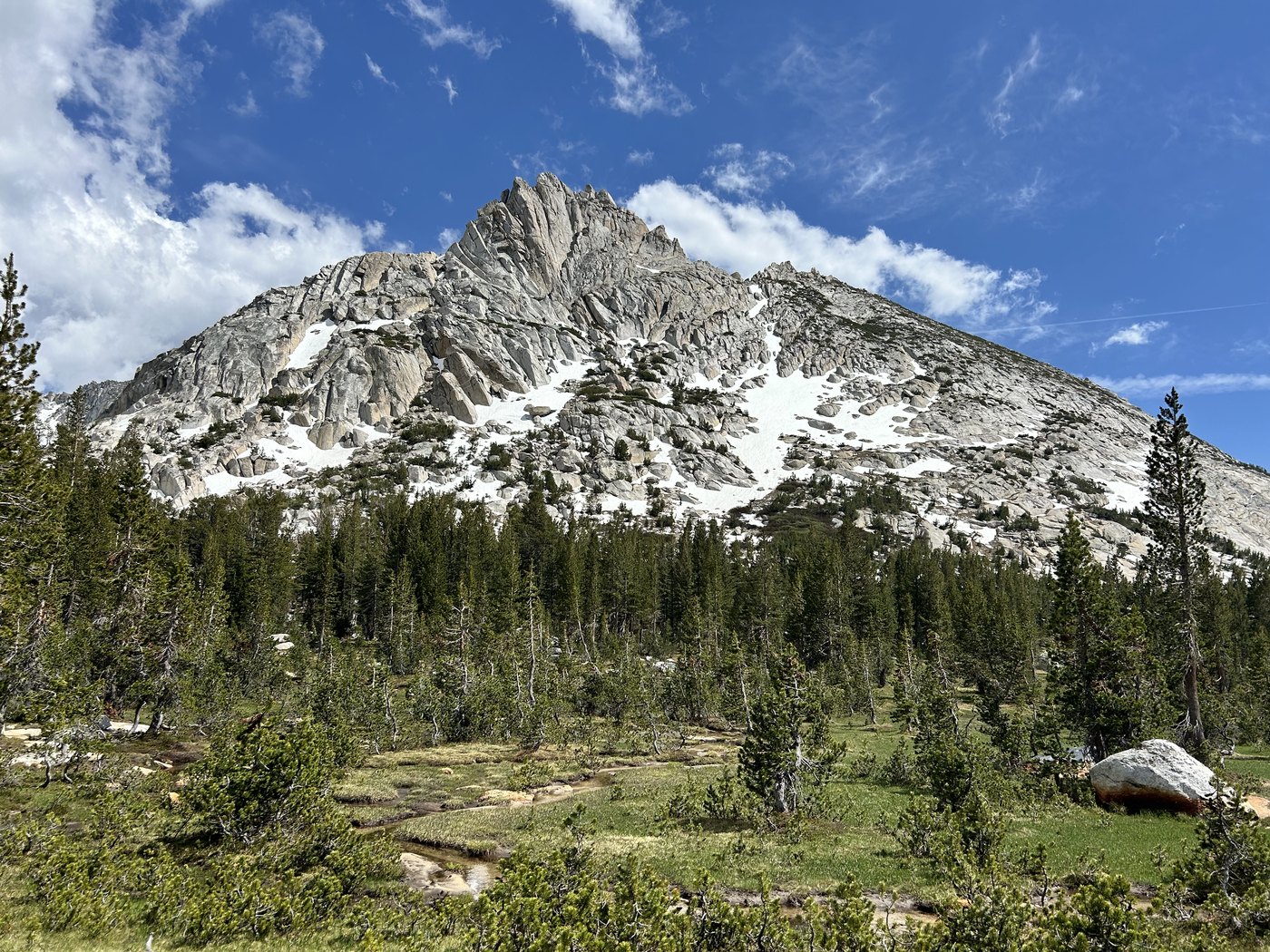
Ragged Peak coming into view in the middle of the afternoon, which is the first honest sign that the climb is nearly spent.
At half past three the timber thinned and Ragged Peak stood up out of the ground ahead of us with old snow still lying in the gullies, and the walking turned from a chore back into the reason we came. We got to the lower lake at five. The whole north side of the basin was still under winter. A long gray ridge runs across the water up there, and in late June that ridge carried unbroken fields of snow from the skyline most of the way down to the trees, close enough to look at and far enough to be somebody else's problem. The snow never once got in our way. We never set a boot on any of that snow.
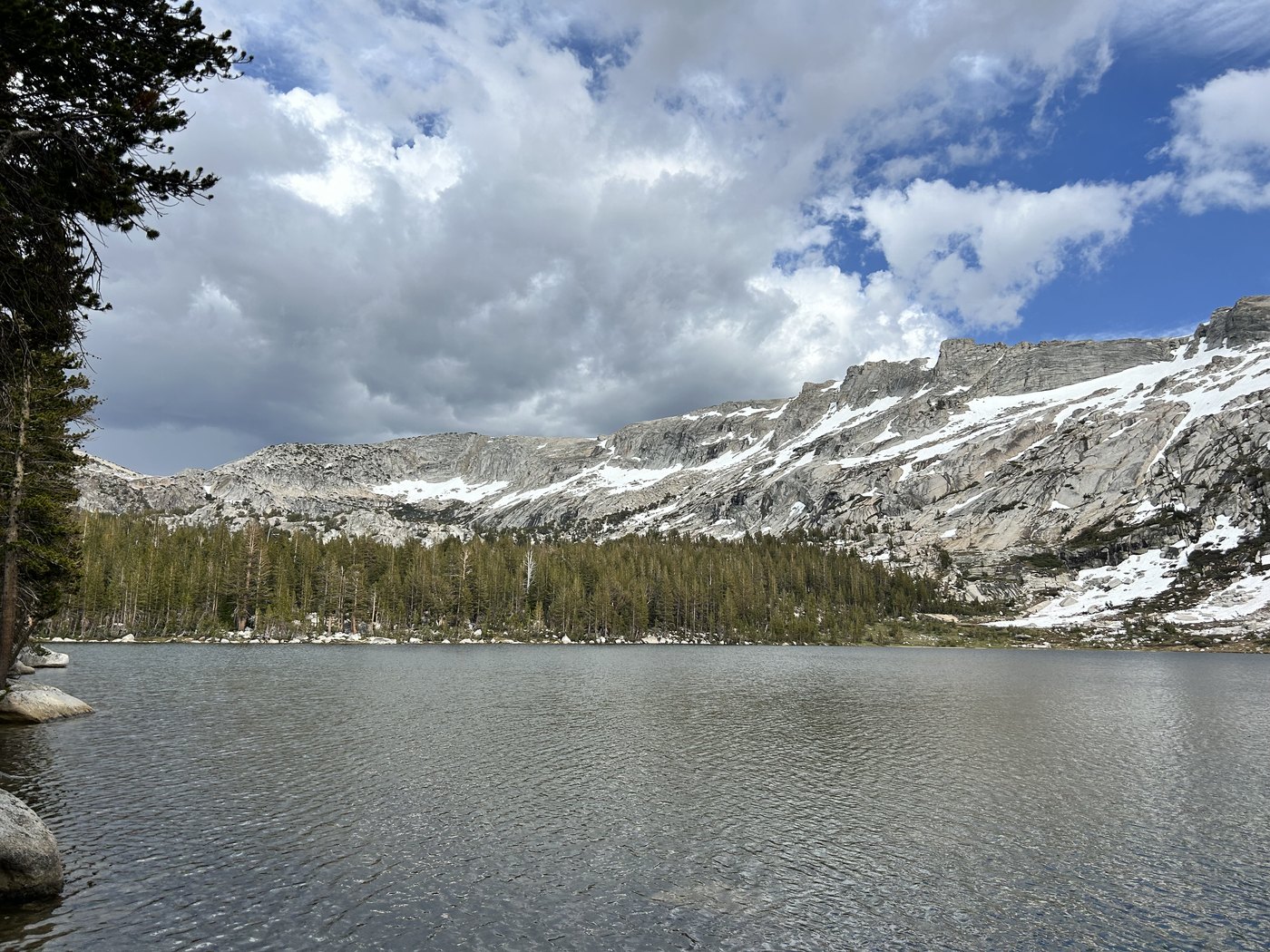
Five in the afternoon at the lower lake. The ridge across the water was still holding most of the winter.
A little under ten thousand feet in June turns cold the moment the sun drops low. I have a photograph of myself at half past five in a down vest with the hood up and a bottle in my hand, looking pleased and slightly braced, which is exactly how the evening felt. The wind came down off the snow and across the water and arrived with the temperature of the ridge rather than the temperature of the afternoon.
Then, around six, the lake went still. Not calm in the ordinary way, but flat to the point of being difficult to look at directly. The snow that had been hard white glare all afternoon lay a second time in the water, and the peak lay under itself point for point, and the clouds that had been running all day over the crest came to a stop and stood in the lake as solidly as they stood in the sky. There is a moment on a high lake at the end of a long afternoon when the wind quits and the granite gives back the last of the day's heat and the whole basin seems to settle into a held breath, and the water stops being a surface and becomes a second country, upside down and perfectly attended to, holding every seam of snow and every dead lodgepole on the far shore with more patience than the mountain itself ever shows. I took nineteen photographs of that reflection in twelve minutes. I was not trying to be thorough. I was trying to get the one that was actually in front of me, and I never got that photograph.
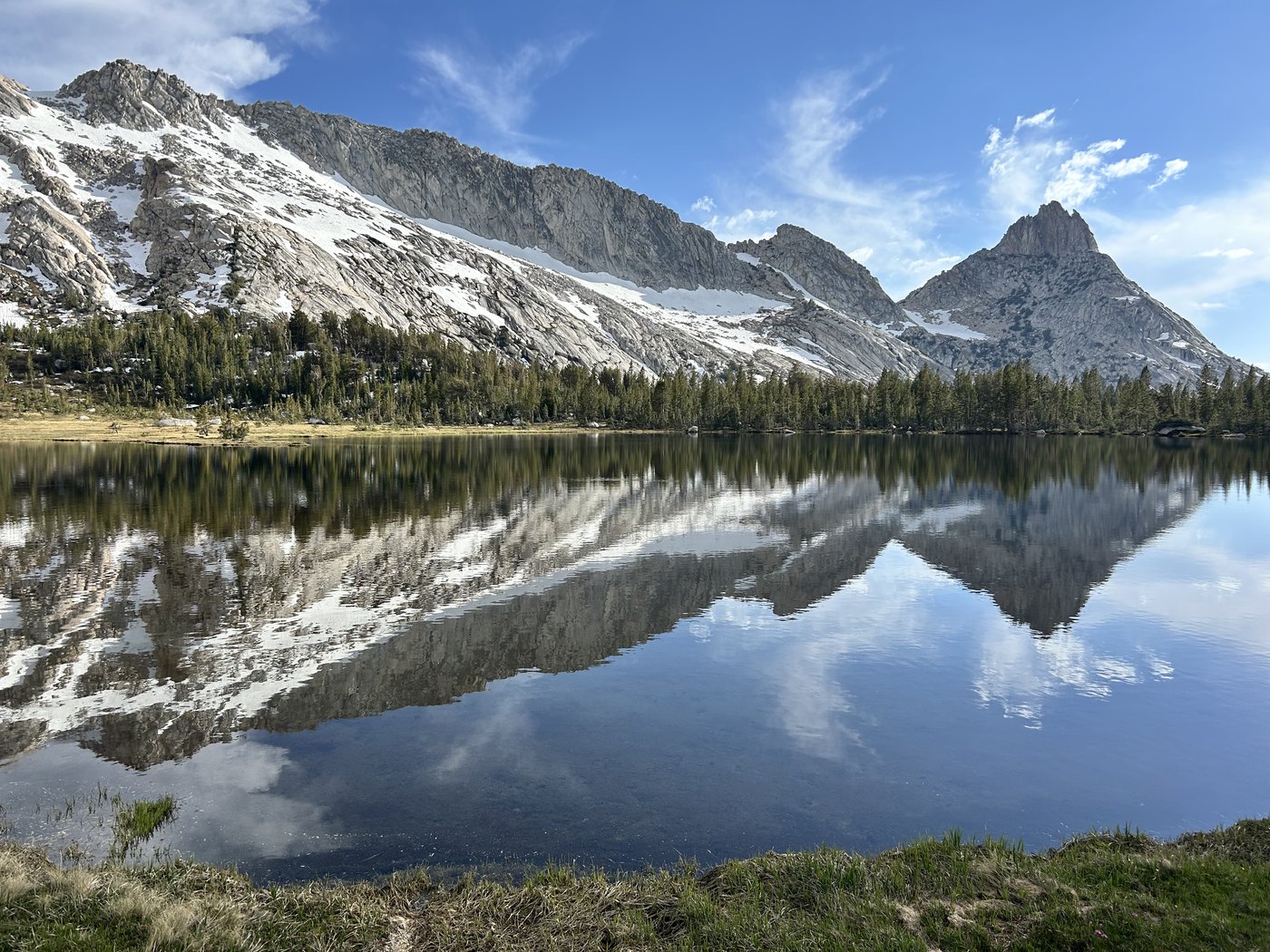
Six in the evening. One of nineteen attempts at a photograph that does not survive being photographed.
My friend had carried a camp chair up there. A one pound folding chair, which by the arithmetic of a pack is an enormous extravagance and by the arithmetic of an evening is the best pound anybody spent all weekend. He sat in the chair. I sat on granite. Neither of us was in any doubt about who had planned better.
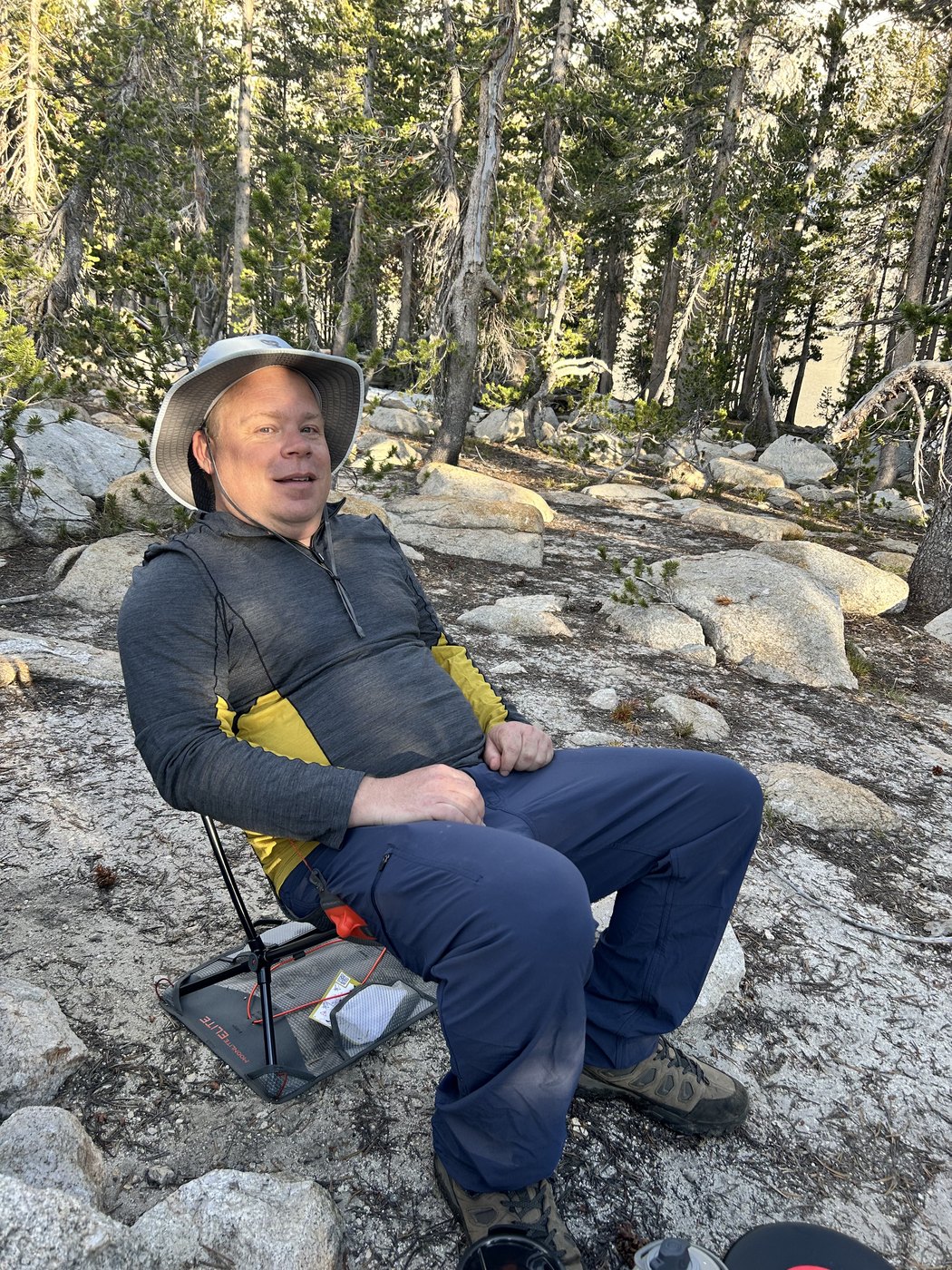
One pound of folding chair at seven in the evening, carried twelve hundred feet uphill and worth every ounce.
We played gin rummy on top of a bear box until the light went. He beat me badly, repeatedly, and without any visible effort, and a bear box turns out to be a nearly ideal card table if you are willing to kneel. The night was cold without ever threatening to freeze, which is the temperature you want at altitude, and I slept the way you only sleep after a day of walking uphill. Between the last card and the first coffee the camera recorded nothing at all, and that is the most accurate account of the evening I could offer.
The lake did the trick again in the morning. Ten past eight, no wind, a sky so deep blue the color looked applied rather than natural, and the twin summits standing in the water as cleanly as they stood in the air. I took another fourteen photographs. I did not get that one either.
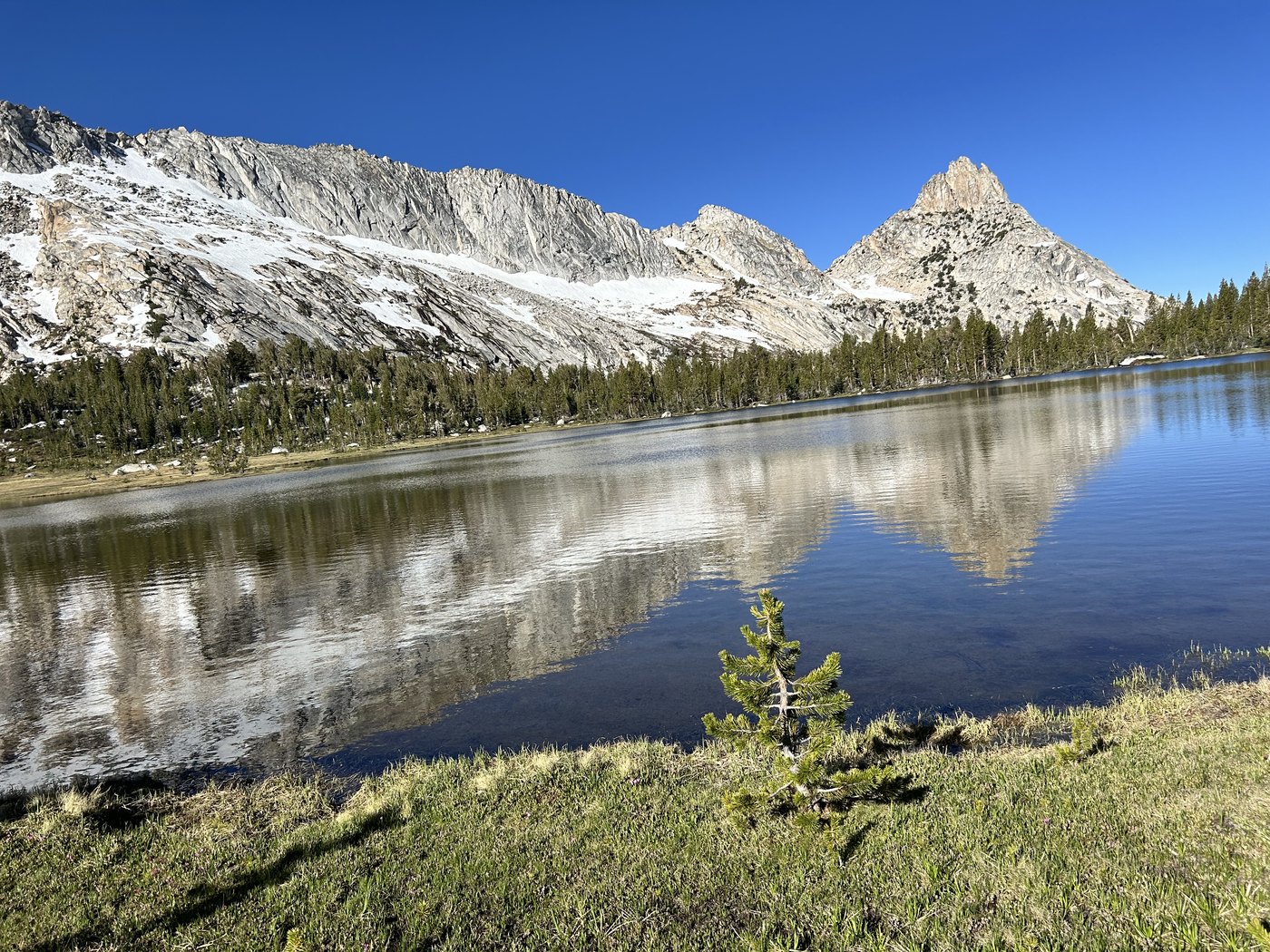
Ten past eight the next morning, before anything had a chance to disturb the water.
We packed and walked out at half past eight, around the lake and up over the shoulder onto the Dog Lake side of the loop. The high open country between the lakes and the meadows is the best walking of the whole route, sandy tread through short grass with the Cathedral Range standing along the southern horizon the entire way, and for two hours the trip was as pleasant as any two hours I have spent in Yosemite.
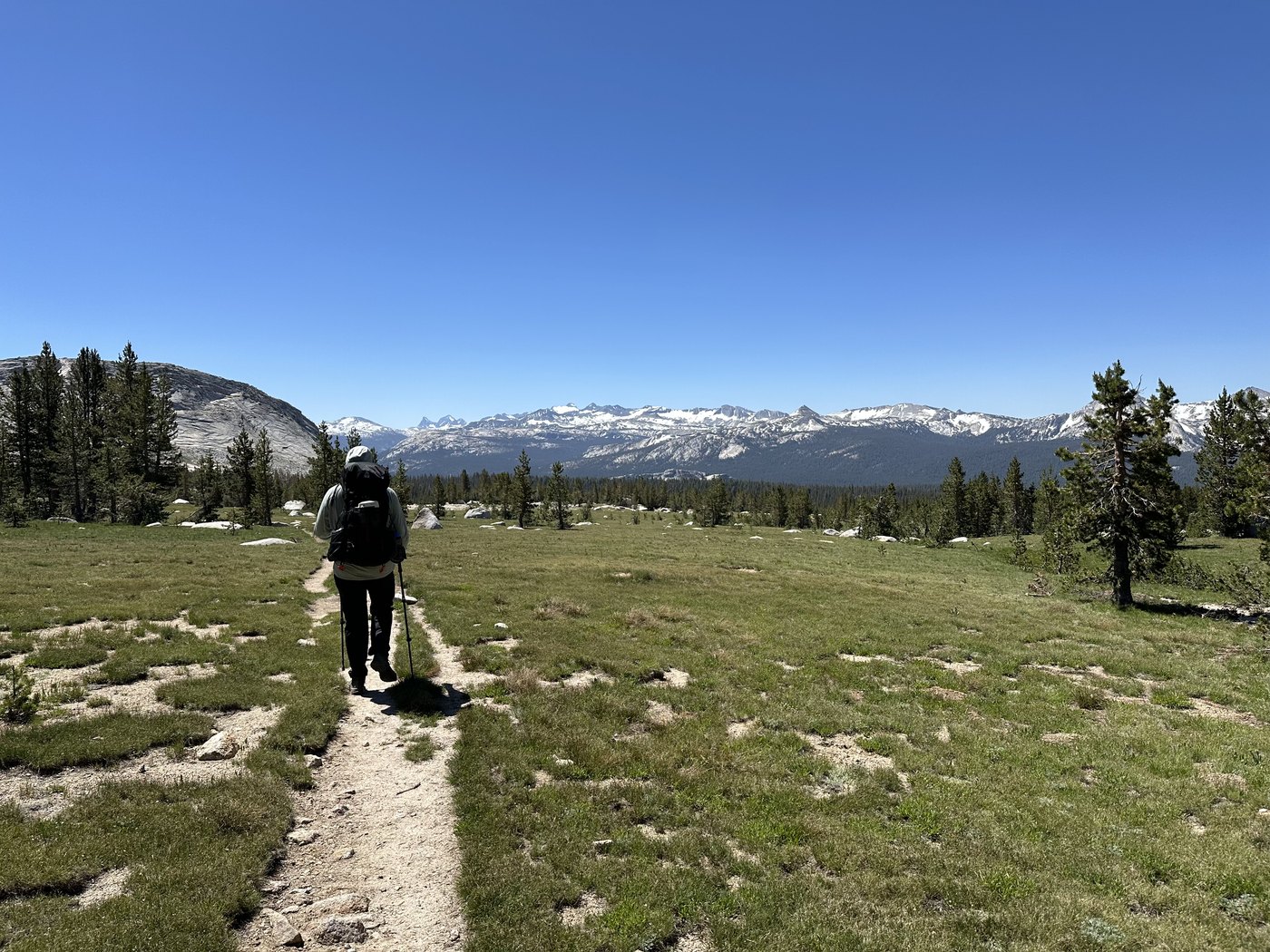
The Dog Lake side on the way home, with the Cathedral Range on the horizon the whole way. This is the last easy hour of the trip.
Then the trail dropped back toward Delaney Creek, and the mosquitos came out of the north to meet us.
They arrive as a condition rather than as insects. You walk into a hundred yards of them and out the other side and then into the next hundred, and each time the volume of the air changes. Waving accomplishes nothing. Walking faster accomplishes a little, and walking faster is the whole strategy, and the strategy has one fatal flaw in the route, which is that the route makes you cross the creek. A crossing takes time. You have to find the log, you have to get your poles set, you have to watch your feet, and every one of those seconds is a second you are standing still in the open next to standing water. The bank that had been empty the day before was not empty now. They know a crossing is coming. They gather at the creek because everybody has to stop at the creek.
Neither of us has ever been eaten like that. Two grown men in reasonable shape on flat ground in the last two miles of an easy weekend, and by the end of that walk we were close to undone. No single bite mattered. Death by a thousand cuts is my friend's phrase for what happened and I have not found a better one. The photographs stop almost entirely for that stretch, four frames in the last two hours, which is what a camera roll looks like when nobody is willing to hold still long enough to take a picture.
We passed people heading in near the end. We told them about the mosquitos. We talked fast, and we talked over each other, and I heard the word swarms come out of my own mouth. They thanked us politely and kept walking, and I understood exactly what they were doing, because I had done the same to a couple at the same creek the day before.
There was no Backpackers Friend on that trip. June of 2024 was still all notebooks and evenings, and for the map I was carrying somebody else's app, which did the map part of the job perfectly well. Nothing about that weekend went wrong for want of navigation. We knew where we were the entire time. What we did not have was any way to weigh a stranger's report against our own, and no app has solved that one yet.
What that trip did put into the app was the chair. A one pound luxury is only a good decision if you know what the other twenty-five pounds are doing, and for years the honest answer in my pack was that I had no idea. Backpackers Friend keeps a gear list per trip with the weight of every item on the list, adds the total up as you pack, and shows you where the weight actually sits by category, so the argument about the chair becomes a short one that ends in a number. Every trip since, my friend has carried that chair. Every trip since, I have thought about that chair.
Go in late September if the bugs are the deciding factor, or go in June and go through Delaney Creek fast and covered. The lakes are worth the trip in either month. Take the chair.
Know what your pack weighs before you argue about a chair
Backpackers Friend holds the gear list for each trip with the weight of every item, adds the total up as you pack, and breaks the load down by category so you can see where the pounds are going. Plan the days, mark the camps, cache the map before you leave. Free to start, works fully offline, no account required.